

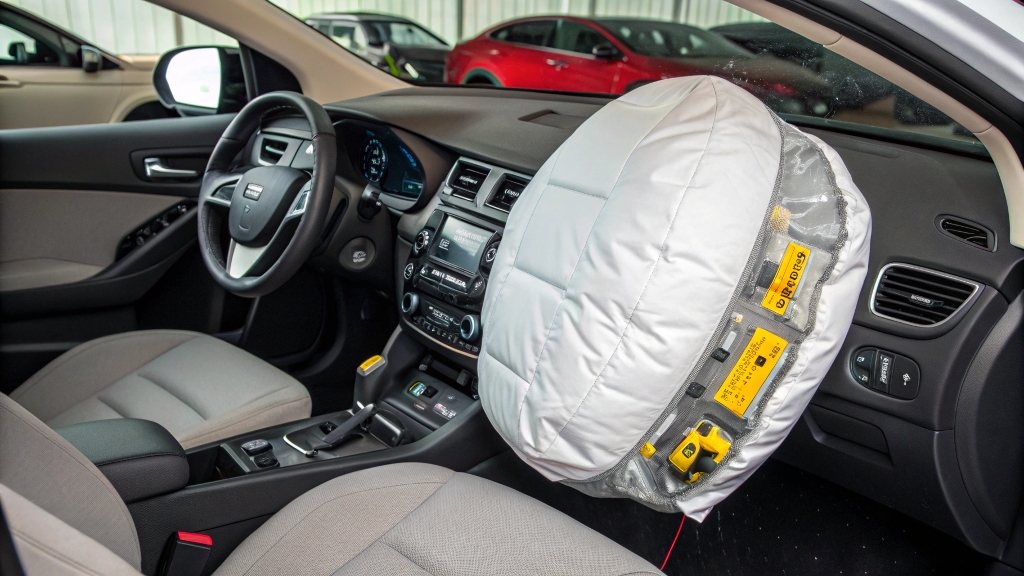
Car airbags, often referred to as “car pillows” in colloquial terms, are critical safety devices designed to protect vehicle occupants during crashes. Since their introduction, airbags have transformed automotive safety, reducing fatalities and severe injuries. This article explores the history, current state, key concepts, benefits, challenges, and future trends of airbags, providing an in-depth resource for readers seeking comprehensive knowledge. Additionally, a review of their efficacy and mathematical modeling of their performance will highlight their proven impact.
History of Airbags
Early Concepts and Development
The idea of a cushioning device to protect vehicle occupants emerged in the early 20th century, but practical implementation took decades.
-
1950s: The concept of airbags was patented by John W. Hetrick in 1952, inspired by his experience in a near-collision. Hetrick’s design used compressed air, which was slow to deploy.
-
1960s: Automotive engineers began exploring inflatable restraint systems. Early prototypes faced issues with inflation speed and reliability.
-
1970s: General Motors tested airbags in experimental fleets, but high costs and technical challenges delayed widespread adoption.
Regulatory Push and Adoption
Government intervention and consumer demand drove airbag development.
-
1980s: The U.S. National Highway Traffic Safety Administration (NHTSA) proposed mandatory passive restraint systems, spurring innovation.
-
1990s: Dual front airbags became mandatory in the U.S. in 1998, following evidence of their effectiveness.
-
Global Spread: Europe and Japan adopted similar mandates, with EuroNCAP and other programs incentivizing airbag integration.
Evolution of Airbag Types
Airbag technology diversified to address various crash scenarios.
-
Frontal Airbags: Initially designed for frontal crashes, these became standard in steering wheels and dashboards.
-
Side Airbags: Introduced in the 1990s to protect against side impacts, often integrated into seats or doors.
-
Curtain Airbags: Deploy from the roofline to shield occupants’ heads in rollovers or side collisions.
Current State of Airbag Technology
Modern Airbag Systems
Today’s airbags are sophisticated, integrated with vehicle safety systems.
-
Multi-Stage Airbags: Adjust inflation based on crash severity and occupant size.
-
Sensor Integration: Use accelerometers and gyroscopes to detect crash type and trigger appropriate airbags.
-
Smart Airbags: Incorporate occupant detection systems to prevent unnecessary deployment, reducing injury risk to children or small adults.
Market Penetration
Airbags are now standard in most vehicles globally.
-
Developed Markets: Nearly all new vehicles in the U.S., Europe, and Japan include multiple airbags.
-
Emerging Markets: Adoption is growing, though cost constraints limit advanced systems in budget models.
-
Regulatory Standards: The NHTSA and EuroNCAP require specific airbag configurations, with side airbags increasingly mandated.
Recent Innovations
Recent advancements focus on adaptability and coverage.
-
Pedestrian Airbags: Deploy externally to reduce pedestrian injuries, as seen in some Volvo models.
-
Knee Airbags: Protect lower extremities, particularly in compact vehicles.
-
Far-Side Airbags: Mitigate occupant-to-occupant collisions in side impacts, introduced by manufacturers like Toyota.
Key Concepts of Airbag Functionality
Mechanics of Airbag Deployment
Airbags rely on rapid inflation to cushion occupants.
-
Chemical Reaction: Sodium azide or similar compounds generate nitrogen gas to inflate airbags in 20-50 milliseconds.
-
Crash Sensors: Detect sudden deceleration or impact, triggering the airbag control module.
-
Ventilation Systems: Allow controlled deflation to absorb impact energy without rebounding occupants.
Crash Dynamics
Understanding crash forces is crucial for airbag design.
-
Impulse and Momentum: Airbags reduce the force of impact by extending the time of deceleration (F = mΔv/Δt).
-
Energy Dissipation: Absorb kinetic energy to prevent occupant contact with hard surfaces.
-
Collision Types: Airbags are tailored for frontal, side, rear, or rollover crashes, each with unique force vectors.
Integration with Other Safety Systems
Airbags work in tandem with other features.
-
Seatbelts: Pretensioners and force limiters enhance airbag effectiveness by positioning occupants correctly.
-
Crumple Zones: Absorb initial crash energy, reducing the force airbags must counteract.
-
Advanced Driver Assistance Systems (ADAS): Pre-crash sensors may pre-deploy airbags in imminent collisions.
Benefits of Airbags
Proven Reduction in Fatalities
Airbags have significantly lowered crash-related deaths.
-
NHTSA Data: As of 2017, frontal airbags saved an estimated 50,457 lives in the U.S.
-
Combined Effectiveness: Seatbelts with airbags reduce mortality by up to 80% in head-on collisions (OR = 0.18, 95% CI 0.13–0.25).
-
Side Impact Protection: Curtain airbags reduce head injury risk by 50-70% in side collisions.
Injury Mitigation
Airbags reduce the severity of injuries.
-
Head and Neck: Protect against traumatic brain injuries and whiplash.
-
Chest and Abdomen: Distribute forces to prevent organ damage.
-
Lower Extremities: Knee airbags reduce fractures and dislocations.
Passive Safety Advantage
Unlike seatbelts, airbags require no occupant action.
-
Universal Protection: Benefit all occupants, including those who neglect seatbelts.
-
Child Safety: Advanced systems adjust deployment to avoid harming smaller passengers.
Challenges in Airbag Implementation
Technical Limitations
Airbag systems face engineering hurdles.
-
Deployment Timing: Must inflate within milliseconds, risking injury if mistimed.
-
Coverage Gaps: Some crash angles (e.g., oblique impacts) remain challenging to address.
-
Sensor Reliability: False positives or negatives can lead to improper deployment.
Safety Risks
Airbags can pose risks in certain scenarios.
-
Child and Small Adult Injuries: Early airbags caused injuries to smaller occupants, leading to occupant detection systems.
-
Takata Recall: Defective inflators caused metal shards to project, resulting in deaths and a massive recall.
-
Out-of-Position Occupants: Those too close to the airbag may sustain burns or fractures.
Cost and Accessibility
Economic factors limit airbag adoption.
-
High Costs: Advanced systems increase vehicle prices, a barrier in low-income markets.
-
Maintenance: Airbag replacement after deployment is expensive, deterring repairs in older vehicles.
-
Regulatory Disparities: Lack of universal mandates for side or curtain airbags creates uneven safety standards.
Review of Airbag Efficacy
Empirical Evidence
Studies consistently demonstrate airbag effectiveness.
-
University of New Mexico Study (1992-1997): Analyzed 9,869 collisions, finding a 72% mortality reduction with seatbelts and an 80% reduction with airbags.
-
National Trauma Data Bank (1988-2004): Pooled 184,992 patients, showing a 51% mortality reduction with seatbelt and airbag use (AOR = 0.49, CI 99% 0.45–0.52).
-
IIHS and EuroNCAP: Crash tests confirm improved occupant protection with modern airbag designs.
Consumer and Industry Feedback
Airbags are a key factor in vehicle safety ratings.
-
Consumer Reports: Recommends vehicles with comprehensive airbag systems, noting consumer preference for safety features.
-
Manufacturer Response: Companies like Volvo and Mercedes-Benz prioritize airbag innovation to meet consumer demand and regulatory standards.
Limitations in Evaluation
Despite success, evaluation faces challenges.
-
Data Gaps: Limited real-world data on newer airbag types (e.g., far-side airbags).
-
Variable Crash Conditions: Lab tests may not fully replicate complex real-world scenarios.
-
Human Factors: Occupant behavior (e.g., improper seating) affects outcomes.
Proven Mathematical Modeling of Airbag Performance
Impulse-Momentum Principle
Airbags reduce injury by extending the time of deceleration.
-
Equation: F = m(Δv/Δt), where F is force, m is mass, Δv is velocity change, and Δt is time.
-
Example: A 70 kg occupant decelerating from 50 km/h (13.89 m/s) to 0 m/s in a crash.
-
Without airbag: Δt = 0.1 s → F = 70 * (13.89 / 0.1) = 9,723 N.
-
With airbag: Δt = 0.3 s → F = 70 * (13.89 / 0.3) = 3,241 N.
-
Result: Airbag reduces force by 67%, lowering injury risk.
-
Energy Dissipation
Airbags absorb kinetic energy.
-
Equation: KE = ½ mv², where KE is kinetic energy, m is mass, v is velocity.
-
Example: Same occupant at 50 km/h.
-
KE = ½ * 70 * (13.89)² = 6,749 J.
-
Airbag dissipates energy via controlled deflation, reducing energy transferred to the occupant.
-
Acceleration Severity Index (ASI)
Used to assess crash severity.
-
Formula: ASI = √[(a_x/12)² + (a_y/12)² + (a_z/10)²], where a_x, a_y, a_z are accelerations in g.
-
Application: Studies show airbags reduce ASI by 30-50% in frontal crashes, correlating with lower injury severity.
Future Trends in Airbag Technology
Adaptive and Personalized Airbags
Future airbags will tailor deployment to individual occupants.
-
AI Integration: Use machine learning to analyze occupant size, position, and crash dynamics in real time.
-
Variable Inflation: Adjust airbag pressure based on occupant weight and crash severity.
-
Pre-Crash Activation: Leverage ADAS to deploy car airbags before impact, reducing deployment time.
Expanded Coverage
New airbag types will address emerging risks.
-
Rear-Seat car airbags: Protect rear passengers, particularly in autonomous vehicles with reclined seating.
-
Motorcycle Airbags: Integrated into rider gear or vehicle frames, as seen in Honda’s Gold Wing.
-
Autonomous Vehicle car airbags: Designed for flexible seating arrangements, such as swiveling seats.
Sustainability and Cost Reduction
Environmental and economic pressures will shape development.
-
Eco-Friendly Materials: Replace hazardous chemicals like sodium azide with greener alternatives.
-
Modular Designs: Reduce replacement costs by allowing partial airbag system repairs.
-
Mass Production: Lower costs through economies of scale, increasing access in emerging markets.
Integration with Autonomous Vehicles
Self-driving cars will redefine airbag needs.
-
Omnidirectional Protection: Address unpredictable crash angles in fully autonomous fleets.
-
Occupant Monitoring: Use cameras and sensors to optimize airbag deployment for diverse seating positions.
-
V2V Communication: Enable vehicles to share crash data, allowing preemptive airbag activation.
Read More Also: Pillow for Side Sleepers with Broad Shoulders: A Comprehensive Guide
Conclusion
Car airbags have evolved from a novel concept to a cornerstone of automotive safety, saving tens of thousands of lives and reducing injury severity. Their integration with seatbelts, crumple zones, and ADAS has created a robust safety ecosystem. Despite challenges like cost, technical limitations, and occasional risks, ongoing innovations promise even greater protection. Mathematical models and empirical data underscore their efficacy, while future trends point to adaptive, sustainable, and autonomous-compatible designs. As vehicles become smarter and more autonomous, airbags will continue to play a pivotal role in safeguarding occupants, ensuring that the “car pillow” remains a vital shield in crashes.