

Pack memory foam camping pillows when comfort, neck support, and dependable sleep matter more than saving every ounce. They mold around your head, stay quiet, and provide a more familiar feel than many inflatable alternatives. Modern memory foam camping pillows can also compress significantly for easier transport. Many compressible foam models weigh roughly 8 to 16 ounces, while some pack near water-bottle size. That makes them especially practical for car camping, basecamps, road trips, and comfort-focused outdoor adventures.
Key Takeaways
- Memory foam provides stable support without inflatable pillow movement.
- Shredded foam offers better adjustability and easier compression.
- Solid foam usually delivers stronger, more consistent support.
- Foam pillows suit car camping better than ultralight backpacking.
- Higher loft generally helps side sleepers maintain comfortable alignment.
- A washable cover improves hygiene during repeated outdoor use.
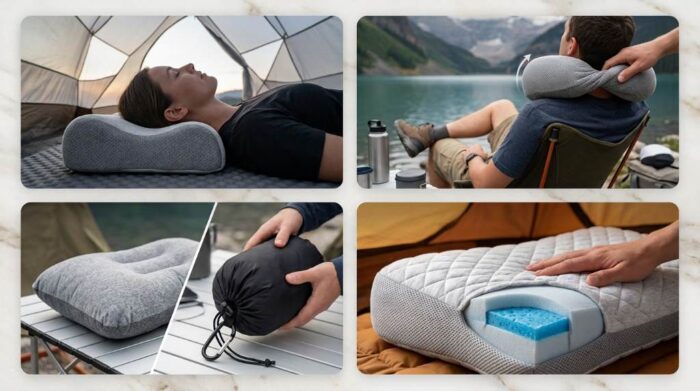
What Makes Memory Foam Worth Packing?
The biggest reason to pack memory foam comes down to predictable comfort. Instead of relying on clothing or uneven gear, you get a purpose-built surface supporting your head and neck. Moreover, memory foam responds gradually to pressure and distributes contact across a wider area.
That response can feel particularly useful after long hikes, paddling sessions, driving days, or active campground schedules. Your sleeping setup already includes a sleeping pad and sleeping bag, so adding proper head support completes the system. Consequently, a better pillow can make your entire sleep setup feel more intentional.
It Feels More Like Your Bed
Many campers struggle with inflatable pillows because their surface feels unfamiliar. Air chambers can create a buoyant sensation that differs significantly from traditional bedroom pillows. Memory foam instead provides a grounded feel that many sleepers recognize immediately.
Furthermore, foam does not require inflation before bedtime. You simply unpack it, allow it to regain its shape, and adjust your sleeping position. That simplicity becomes valuable when temperatures drop or fatigue makes complicated setup less appealing.
Memory Foam Provides Consistent Neck Support
A camping pillow should fill the space between your head and sleeping surface without forcing your neck upward. Memory foam helps accomplish this by conforming around pressure points rather than behaving like a rigid block. Therefore, the right pillow can feel supportive without creating unnecessary pressure.
Side sleepers often benefit from greater pillow height because their shoulders create a wider gap. Back sleepers usually prefer moderate loft that supports the natural curve beneath their neck. Stomach sleepers generally need lower loft because excessive height can push the neck into an uncomfortable position.
Choose Loft Around Your Sleeping Position
- Side sleepers: Look for medium to high loft and supportive foam.
- Back sleepers: Choose moderate loft with balanced firmness.
- Stomach sleepers: Favor lower loft and softer compression.
- Combination sleepers: Consider shredded foam with adjustable fill.
However, sleeping position should not determine your choice alone. Shoulder width, mattress firmness, personal preference, and pillow shape also influence the ideal height. Test the pillow with your sleeping pad whenever possible before committing to longer trips.
Shredded Versus Solid Memory Foam
Not every memory foam camping pillow behaves the same way. Solid memory foam creates a more uniform support surface, while shredded foam allows greater movement within the pillow. Understanding that difference helps you avoid buying a pillow that feels wrong outdoors.
When Solid Foam Makes Sense
Solid foam works well for campers who prioritize structured support and consistent pressure distribution. It can feel especially stable for side sleepers who dislike pillows collapsing beneath their heads. However, solid foam usually sacrifices some packability because its structure resists deep compression.
Therefore, solid foam suits car campers, RV travelers, and established basecamps particularly well. If your vehicle carries most of your equipment, the extra bulk rarely creates a meaningful disadvantage.
When Shredded Foam Wins
Shredded foam provides more flexibility because you can shift the filling beneath your head. You can flatten one area, build another, or reshape the pillow around your preferred sleeping position. Additionally, shredded construction usually compresses more easily than dense solid foam.
That makes shredded memory foam a strong compromise for campers who want comfort without carrying a full-size bedroom pillow. It works especially well when moderate packability matters alongside support.
Why Foam Can Beat an Inflatable Pillow
Inflatable pillows clearly win when weight and packed size dominate the decision. They can collapse extremely small and often allow users to adjust firmness by controlling air pressure. Nevertheless, that advantage does not automatically make them better for every camper.
Memory foam eliminates the need for valves, inflation, and repeated firmness adjustments. It also avoids the possibility of waking because an air chamber feels different after several hours. More importantly, foam generally produces a quieter sleeping surface when you move during the night.
| Feature | Memory Foam | Inflatable |
|---|---|---|
| Comfort feel | Grounded and cushioning | Buoyant and adjustable |
| Packability | Moderate | Excellent |
| Setup | Unpack and reshape | Inflate and adjust |
| Noise | Usually quiet | Can produce movement noise |
| Leak concern | None | Possible |
| Best use | Comfort-focused camping | Weight-focused trips |
Think About Your Trip Before Your Pillow
The best camping pillow depends heavily on how you travel. A pillow that feels perfect beside your vehicle can become an unnecessary burden during a long backpacking route. So, match pillow characteristics with transportation rather than choosing solely by comfort ratings.
- Car camping: Prioritize comfort, support, and generous dimensions.
- RV camping: Choose a larger model when storage allows it.
- Basecamp trips: Favor durable foam and substantial cushioning.
- Road trips: Choose compressible designs that work beyond camp.
- Backpacking: Consider lightweight hybrid or inflatable alternatives.
For backpacking, every ounce eventually becomes part of your daily workload. Consequently, a compact inflatable pillow may make more sense when you carry your entire shelter. For vehicle-based camping, however, comfort often deserves greater priority.
Cold Weather Camping Changes the Equation
Temperature can influence how comfortable a camping pillow feels during the night. Air-filled pillows can feel noticeably cool because air does not provide the same cushioning sensation as foam. Foam construction can create a warmer, more substantial surface beneath your head.
Still, memory foam does not automatically solve every cold-weather problem. Your sleeping pad, sleeping bag, clothing, and campsite location affect overall warmth far more significantly. Use the pillow as one component of a properly insulated sleep system.
Packability Depends on More Than Compression
Many shoppers look only at how much a pillow compresses. Yet packed dimensions, shape, storage method, and recovery time also determine practical portability. A pillow that compresses well but requires excessive force may become frustrating during repeated packing.
Before purchasing, check the compressed dimensions and included storage system. Also consider whether the pillow returns to full loft quickly enough for your routine. A good camping pillow should move easily from storage mode to sleeping mode without unnecessary effort.
A Simple Packing Method
- Remove the pillowcase or outer cover if the design allows it.
- Fold or roll the foam according to its natural compression points.
- Use the supplied strap or stuff sack to maintain compression.
- Place the pillow near accessible gear rather than buried underneath equipment.
- Allow the foam to expand fully before sleeping on it.
Do not force a foam pillow into a storage sack smaller than its intended packed dimensions. Excessive compression can make packing inconvenient and may interfere with the pillow’s normal recovery.
Do Not Ignore the Pillow Cover
Outdoor environments expose sleeping gear to sweat, dust, moisture, sunscreen, food residue, and campsite debris. A removable washable cover therefore offers more value than its simple appearance suggests. It also makes repeated trips easier because you can clean the contact surface without washing the foam.
Look for durable fabric with comfortable skin contact and practical moisture resistance. Additionally, inspect the zipper because rough hardware can become annoying when you use the pillow every night. A thoughtful cover design can significantly improve long-term usability.
When Memory Foam Is the Wrong Choice
Memory foam does not suit every outdoor sleeper or every trip. If you count every gram, carry a tiny pack, or hike long distances daily, an inflatable pillow may offer a better balance.
Likewise, memory foam may disappoint campers who expect a pillow to disappear completely inside their backpack. Foam compresses, but it generally cannot match the packed volume of dedicated ultralight air designs. Recognizing that tradeoff prevents unrealistic expectations.
Skip Memory Foam If You Prioritize
- Extremely low base weight
- Minimal packed volume
- Adjustable firmness through inflation
- Long-distance backpacking efficiency
- Maximum storage efficiency inside small packs
How to Test a Camping Pillow Before a Long Trip
Do not judge a camping pillow after resting your head on it for thirty seconds. Instead, recreate your actual sleep system using your camping pad and preferred sleeping position. Then spend enough time on the pillow to notice pressure, movement, and loft issues.
Pay attention to whether your head remains centered after turning. Also notice whether your neck feels supported without forcing your chin upward. Finally, test the pillow while wearing the layers you normally use during cooler nights.
Use This Five-Point Field Test
- Support: Does your neck remain naturally positioned?
- Stability: Does the pillow stay beneath your head?
- Comfort: Does pressure remain evenly distributed?
- Packability: Can you compress and store it easily?
- Recovery: Does it regain useful loft after unpacking?
These checks reveal more than a product description alone. They also help separate genuine sleep-system compatibility from attractive specifications that may not matter during real camping.
Memory Foam Camping Pillow Buying Checklist
Start with your sleeping style, then consider your transportation method and available storage. Afterward, compare foam construction, loft, dimensions, weight, cover materials, and packed size.
- Choose the loft that matches your sleeping position.
- Decide between solid and shredded foam.
- Confirm the pillow fits your sleeping bag or shelter space.
- Check the packed dimensions, not just the full dimensions.
- Look for a removable and washable cover.
- Consider moisture resistance for frequent outdoor use.
- Evaluate weight against your actual transportation method.
- Check whether the pillow includes a compression system.
Most importantly, do not pay for portability you will never need. A slightly larger pillow can provide substantially better sleep when your vehicle handles the transportation burden.
Why Better Sleep Can Improve the Entire Camping Experience
Camping already introduces unfamiliar sounds, temperatures, surfaces, and schedules. Your pillow cannot eliminate those variables, but it can remove one unnecessary source of discomfort. That small improvement can make bedtime easier and mornings more pleasant.
Moreover, comfortable sleep affects how you experience the next day’s activities. Whether you plan to hike, fish, paddle, explore, or simply relax, starting rested makes the entire trip feel more rewarding. That makes a quality pillow less of a luxury and more of a practical comfort investment.
Frequently Asked Questions
Are memory foam camping pillows worth packing?
Yes, they are worth packing when comfort and neck support matter more than ultralight weight.
Are memory foam pillows good for backpacking?
They can work for short backpacking trips, but inflatable models usually save more weight and space.
Is shredded memory foam better for camping?
Shredded foam often works better when you want adjustable loft and easier compression.
Do memory foam camping pillows get hot?
Some foam models can retain warmth, so choose breathable covers or cooling constructions for warm conditions.
How should I choose camping pillow height?
Match the loft to your sleeping position while considering your shoulder width and sleeping pad thickness.
Final Verdict
Pack a memory foam camping pillow when reliable comfort, stable support, and a familiar sleeping feel outweigh extreme weight savings. For car camping, RV trips, basecamps, and comfort-focused adventures, foam offers a compelling combination of support and convenience.
Before your next trip, compare your sleeping position, transportation method, available storage, and desired comfort level. Choose the smallest memory foam pillow that still gives your neck the support you actually need.